
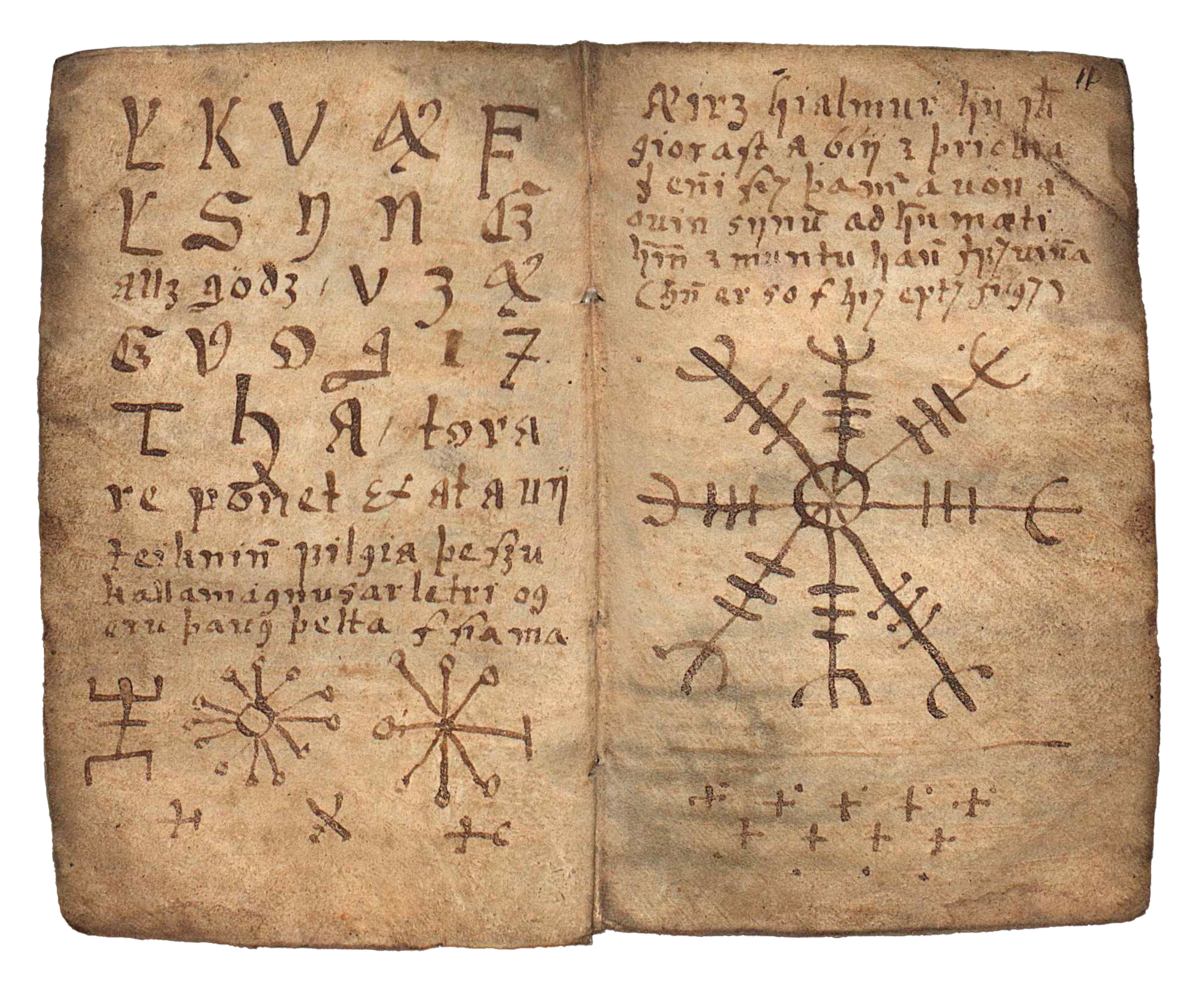
If you’ve spent any time looking into the helm of awe or the vegvísir, you’ve probably run into some version of the same unsettling suggestion: that these symbols are not quite what they’re assumed to be. Not Viking Age. Not ancient. Something else.
That something else has a name. These symbols are galdrastafir — magical staves from a tradition of Icelandic books of magic called the galdrabækur, produced roughly between the sixteenth and nineteenth centuries. And that tradition is worth understanding on its own terms, because it is considerably more interesting than the vague “Norse magic” label that usually gets attached to the symbols instead.
So What Are the Galdrabækur?
The word breaks down simply: galdur, meaning magic or incantation, and bækur, meaning books. Books of magic. At least twenty-four survive in varying states of completeness, though legal and ecclesiastical records from the same period suggest many more once existed. Iceland conducted approximately 130 witchcraft trials between 1554 and 1719, and galdrastafir were cited as evidence in roughly half of them. Owning one of these manuscripts carried genuine risk. The survival rate reflects that.
What survived is a body of practical magic. The spells in the galdrabækur are not mystical or philosophical in character. They are functional: remedies for illness, protections against enemies, tools for finding thieves, winning favour, surviving sea voyages. Their purposes are mundane even when their mechanisms are not. These were not the products of a priestly class or a scholarly order. They were written by people who needed things to work.
The individual symbols within these manuscripts, the drawn figures used in spells and carried as talismans, are the galdrastafir. The word combines galdur, magic or incantation, the same root as in galdrabækur, with stafir, meaning staves. The term carries over from the older Scandinavian vocabulary for runes, which were traditionally carved on wood. That is where the resemblance ends. Galdrastafir are not runes. Many of the manuscripts do include runic alphabets alongside their symbols and sigils, but runes appear there as one ingredient among many, not as the tradition’s foundation. The logic behind galdrastafir is distinct, with its own origins, its own influences, and its own history.

Where the Tradition Actually Starts
The tradition draws from several converging sources, none of them rooted in the Viking Age. Runic writing systems appear throughout the manuscripts, and the terminology of staves carries over from earlier Scandinavian practice. But the runes in these texts belong to post-Viking writing traditions, not the Elder Futhark of the migration period or the Younger Futhark of the Viking Age itself. The resemblance is superficial. What looks like continuity is largely coincidence of vocabulary.
The more significant influences arrived from further afield. From the thirteenth century onward, a body of learned magic associated with the biblical King Solomon had been circulating across Europe in Latin and Greek manuscripts, some claiming Hebrew sources. By the fifteenth century, full grimoires attributed to his name were in wide circulation. Their concerns were entirely practical, punishing enemies, winning lovers, identifying thieves, and they carried with them a visual vocabulary of seals and sigils that had no equivalent in earlier Nordic tradition. That visual vocabulary is the direct ancestor of much of what appears in the Icelandic manuscripts.

These texts also brought Kabbalistic and Christian mystical frameworks with them. The magical formula AGLA, an acronym from the Hebrew Atah Gibor Le-olam Adonai (“You, O Lord, are mighty forever”), appears in Icelandic manuscripts alongside invocations of the Ophanim, a class of celestial beings from Jewish mystical tradition. Early modern European magic was genuinely syncretic, drawing from whatever sources appeared effective without much concern for consistency of tradition. The galdrabækur are a product of that world.
The oldest surviving example, Lækningakver, the Icelandic Leech-Book preserved in the manuscript AM 434 a 12mo, dates to around 1500 and shows this mixture already in place. It is primarily a medical manual, but its magical content is substantial, and it demonstrates the tradition’s character from the start: Christian prayers and Hebrew divine names in the same spells, visual symbols drawn from continental magical traditions, and almost nothing that could be called straightforwardly Nordic. It is the starting point of a tradition that would develop and absorb new influences over the following three centuries.

A Long Standing Tradition
A notable document in the galdrabækur tradition is not among the oldest. The Huld manuscript, catalogued as ÍB 383 4to and held at the National Library of Iceland in Reykjavík, was compiled by Geir Vigfússon in Akureyri in 1860. Its name means “secrecy” in Icelandic. It contains thirty galdrastafir alongside runic alphabets and related material, assembled from earlier sources Vigfússon collected rather than created himself.
1860 is worth sitting with. This is four years before the Second Schleswig War. Abraham Lincoln had just been elected president of the United States. By any measure, this is not the Viking Age.
The Huld manuscript is the earliest known source for the vegvísir. It is one of the key sources for the most widely recognised forms of the ægishjálmur. It is the document most people are unknowingly looking at when they encounter either symbol online, in a tattoo studio, or on jewellery and merchandise. Few people know its name, its date, or where it came from.
It is a genuine historical document, part of a real and documented magical tradition, and the symbols it contains meant something to the people who used them. A nineteenth-century Icelander compiled it from earlier materials, within a tradition that had been developing since the sixteenth century, drawing on a mixture of local folk practice and continental learned magic. Vigfússon was recording a tradition that was already fading.


Notable Galdrastafir Examples
The two most famous galdrastafir in the world both come from this tradition. You’ve almost certainly seen them, even if nobody has told you what they’re called.

The Ægishjálmur
The ægishjálmur, commonly known as the Helm of Awe, is older than the galdrabækur by centuries, but only as a word. It appears in Old Norse literature long before anyone in Iceland drew a symbol by that name, attached to something quite different from what we know today. There’s a dragon involved. Tracing how the word became the symbol is its own story.

The Vegvísir
You’ve probably seen the vegvísir, sold everywhere as the Viking compass. But it missed the Viking Age by about a thousand years. How it became one of the most recognised Viking symbols in the world is a short, clearly documented story.
How They Became Viking Symbols
The galdrabækur were largely unknown outside Iceland until 1989, when Stephen Flowers published his English translation of the Galdrabók under the pen name Edred Thorsson. Flowers is a founding member of the Temple of Set and a committed proponent of esoteric Odinism — a tradition with direct roots in the Germanic nationalist occultism of the nineteenth century, and one that has consistently recast Nordic source material as the spiritual heritage of a superior white northern European people. That is the ideological context in which the ægishjálmur and vegvísir were introduced to the English-speaking world. Most people who encounter the symbols still have no idea.
The symbols spread from there through the networks of the Nordic revival and neopagan movements of the 1990s and 2000s, accumulating associations as they travelled. By the time the internet made image sharing frictionless, the actual manuscript origins were completely invisible. The ægishjálmur and vegvísir had become Viking symbols.

New Life for an Old Tradition
The galdrabækur are not a footnote to Nordic history. They are a tradition in their own right, documented, traceable, and genuinely interesting once you know what you are looking at.
Since Flowers introduced them to the English-speaking world, the ægishjálmur and vegvísir have developed a life entirely their own. Millions of people have chosen these symbols as expressions of protection, guidance, and connection to Nordic heritage, for reasons that have nothing to do with esoteric Odinism. That is its own kind of tradition, built in plain sight over the last few decades.
The galdrabækur are genuinely Nordic, Icelandic folk magic produced in Iceland by Icelanders, within a tradition that carried something real forward from the culture that preceded it. The symbols were never Viking Age, but they were never fake either. In the decades since they entered global tattoo culture, millions of people have taken them up with intention, and a living practice is again developing around them. That is how traditions work. The galdrabækur themselves were doing exactly the same thing.
Sources
Primary Sources
AM 434 a 12mo. Lækningakver. c. 1500. Arnamagnæan Collection, Copenhagen.
ATA, Ämb, 2, F 16:26. Galdrabók. c. 1600. State Historical Museum, Stockholm.
ÍB 383 4to. Huld manuscript. Compiled by Geir Vigfússon, Akureyri, 1860. National Library of Iceland, Reykjavík.
JS 375 8vo. Galdrablöð. Early 19th century. National Library of Iceland, Reykjavík.
Lbs 143 8vo. Galdrakver. 1670. Landsbókasafn Íslands Háskólabókasafn.
Lbs 2413 8vo. Galdraskræða. c. 1800. National Library of Iceland, Reykjavík.
Lbs 2917 a 4to. Galdrakver. Olgeir Geirsson, Akureyri, 1869. National Library of Iceland, Reykjavík.
Lbs 4627 8vo. Galdrakver. 19th century, Eyjafjord area. National Library of Iceland, Reykjavík.
Secondary Sources
Bauer, Alessia. 2021. What is the oldest example of an Icelandic grimoire? The Icelandic Web of Science.
Storesund, Eirik (Brute Norse). 2018. Clubbing Solomon’s Seal: The Occult Roots of the Ægishjálmur.