
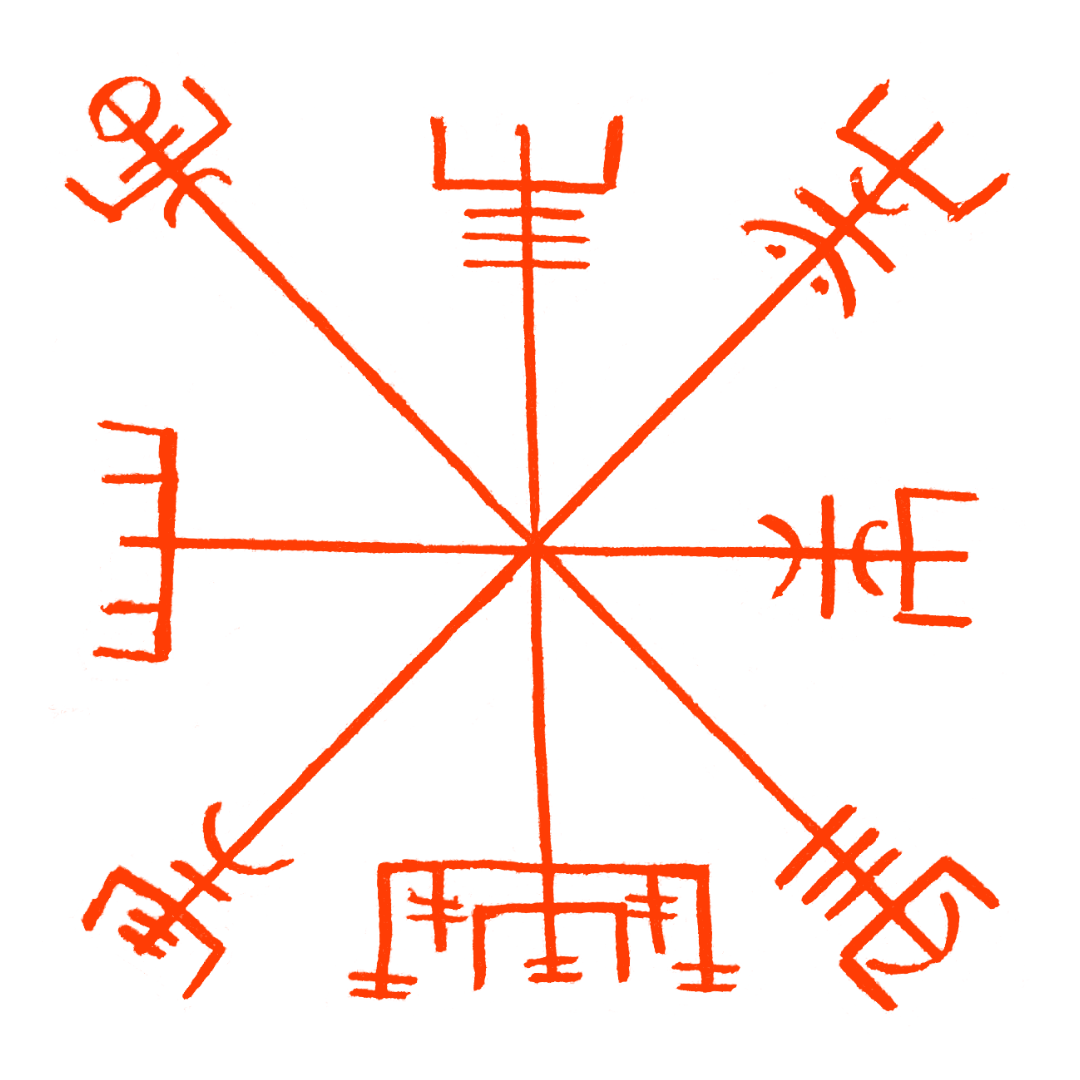
The vegvísir, commonly known as the Viking compass, is everywhere. Tattoos, pendants, T-shirts, album covers, Björk’s left arm, Viking-themed candle holders, you name it.
The actual source is less abundant: three Icelandic manuscripts, all written in the same decade, in the same valley, in the 1860s.
There’s no way around it. That is the entire historical record. The vegvísir is one of the youngest galdrastafir in the Icelandic magical tradition, and almost everything that exists of it today, the tattoos, the pendants, the silver work, the digital art, has been made in the last few decades by people who took the symbol up and gave it new life. The history is short, but the symbol is going strong.
A Handful Manuscripts and That’s It
Three of the few records of the vegvísir in the sources


The vegvísir appears in the historical record only a handful of times. All sources are Icelandic grimoires. All date from the same decade and the same region of Iceland. There is nothing before them.
The earliest is the Huld manuscript, compiled by Geir Vigfússon in Akureyri in 1860. On page sixty, alongside a drawn image of the symbol, Vigfússon recorded the following: “Carry this sign with you and you won’t get lost in storms or bad weather, even in unfamiliar surroundings.” A second source is a galdrakver compiled by Olgeir Geirsson, also in Akureyri, in 1869. A third is an anonymous manuscript from the same period, from the Eyjafjord area close to Akureyri. All three carry essentially the same inscription and the same image. All three point back to the same local tradition.
There is no vegvísir on any runestone. There is no vegvísir on any Viking Age artifact. It does not appear in the Eddas, the sagas, or any medieval Scandinavian source.


What It Was, What It Is
The name is built from Old Norse roots: vegur (way, road) and vísir (guide, pointer). The word itself has real depth in Icelandic and the wider North Germanic languages. The symbol does not. The gap between the two is where most of the confusion lives.
The vegvísir is the real deal, though. It comes from a documented Icelandic magical tradition, the galdrabækur, the books of magic Icelanders wrote between the sixteenth and nineteenth centuries to deal with the practical problems of being alive. People drew these symbols for protection, for guidance, for the journey ahead. That’s what the vegvísir was for.
It’s also what people use it for now. Tattoo artists are reinterpreting it, drawing new variations, putting their own hand on it, and the people walking out of those studios are wearing it for reasons that would have made sense to the Icelanders who first drew it. They’re starting something hard. They’re getting through something harder. The Viking Age never knew this symbol, but plenty of people alive today do, and they are doing real work with it. They want a mark that means they’ll find the way.
Sources
Primary Sources
ÍB 383 4to. Huld manuscript. Compiled by Geir Vigfússon, Akureyri, 1860. National Library of Iceland, Reykjavík.
Lbs 2917 a 4to. Galdrakver. Olgeir Geirsson, Akureyri, 1869. National Library of Iceland, Reykjavík.
Lbs 4627 8vo. Galdrakver. 19th century, Eyjafjord area. National Library of Iceland, Reykjavík.
Secondary Sources
Storesund, Eirik (Brute Norse). 2018. Clubbing Solomon’s Seal: The Occult Roots of the Ægishjálmur.