
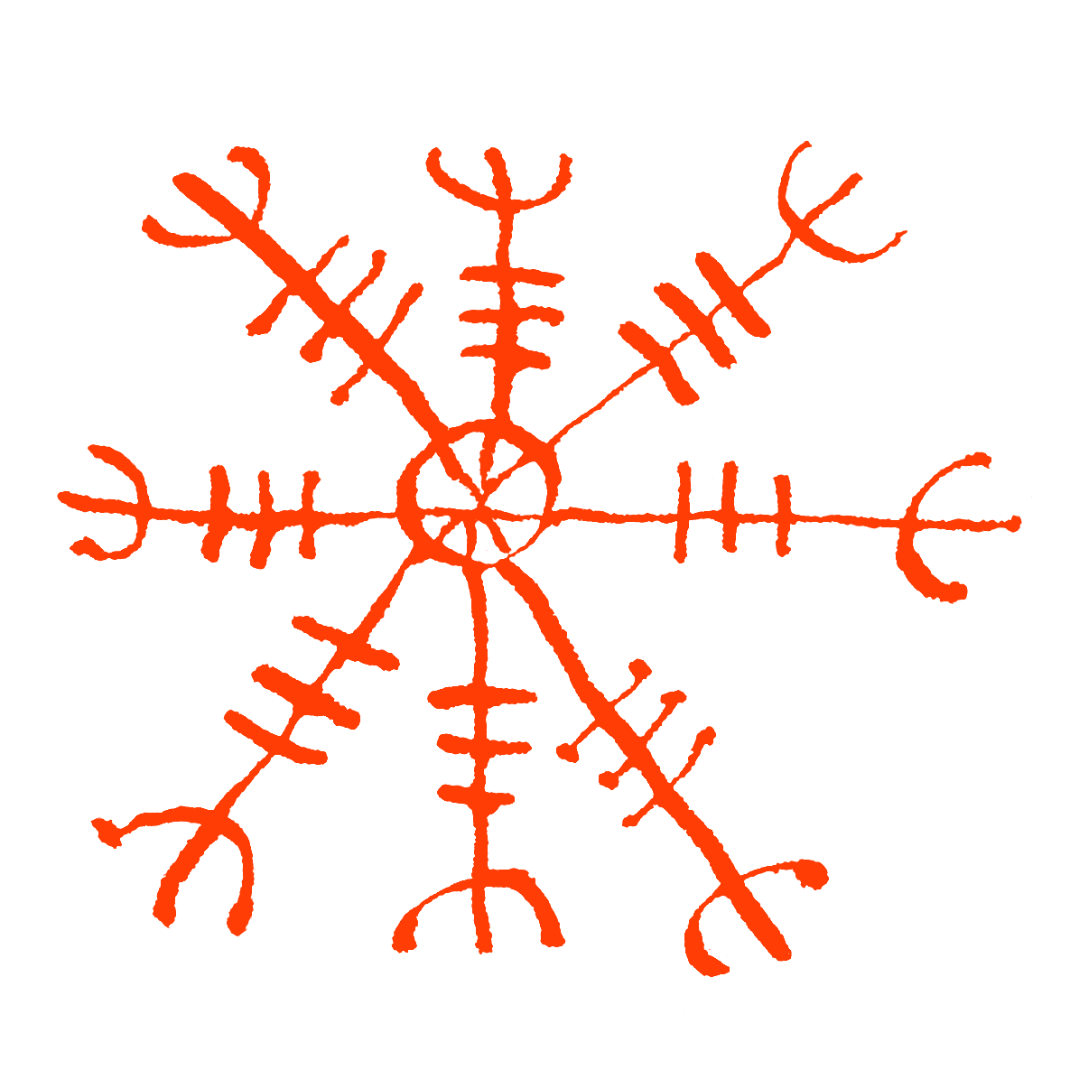
The ægishjálmur, commonly known as the helm of awe, appears on jewellery, in tattoo studios, in games and films, almost always described as an ancient Viking symbol of protection and power. But that is not quite right.
The name appears in the sagas written down well after the Viking Age ended. The symbol is much younger. For centuries the word existed without any drawn symbol attached to it, and what it meant changed substantially along the way. The symbol only arrives near the end of that history, in a tradition of Icelandic books of magic called the galdrabækur, and inherits everything the word had become.
Examples of Ægishjálmur from the Icelandic books of magic


It Started as a Word in the Sagas
The word ægishjálmr appears in Old Norse literature in the 13th century, long before any book of magic was written in Iceland. It appears as a physical object: a helmet, owned by a dragon.
In Fáfnismál, one of the poems of the Poetic Edda, the dwarf-turned-dragon Fáfnir states plainly that he wore the terror-helmet to keep people away from his treasure. There is no suggestion of a sigil, a drawn figure, or anything more abstract than a piece of magical armour worn by a creature renowned for smithcraft.

Snorri Sturluson, retelling the same myth in Skáldskaparmál, is equally unambiguous: “Fáfnir had then taken that helmet that Hreiðmarr had owned, which is called ægishjálmr, and put it on his head, which all living beings are afraid of.” If there was any tradition of a magical symbol called ægishjálmr in Snorri’s time, he was unaware of it. He was not a man who missed such connections when they existed.

By the High Middle Ages the term had developed a second, proverbial use. In Laxdæla saga, the phrase “to bear the helm of terror over someone” appears as an idiom for domination and subjugation. The object had become a metaphor. A gold helmet in a dream, too heavy for its wearer, stands for a future husband who will prove domineering. The physical artifact had given way to something more abstract: a quality, a force, an attribute of particularly powerful individuals.

The final step in this literary development comes in Sǫrla þáttr, a legendary tale preserved in Flateyjarbók, written just before the turn of the fifteenth century. Here the warrior Hǫgni is described as having “the helm of terror in his eyes.” The ægishjálmr has migrated from the head to the gaze. It is no longer an object worn or a metaphor invoked. It is something a person possesses intrinsically, expressed through the eyes, paralysing and disarming those who encounter it.

That trajectory, from magical artifact to proverbial force to weaponised gaze, ran across roughly three centuries of Old Norse literature. It did not produce a symbol. But it produced the conditions for one.
Then the Symbol Showed Up
The first visual appearance of anything resembling the ægishjálmur as a drawn symbol comes in Lækningakver from around 1500, the same manuscript that marks the beginning of the galdrabækur tradition. The earliest example is a primitive cruciform figure, used in a spell intended to stem a chieftain’s anger. The instructions are specific: draw the symbol on your forehead using yarrow drenched in your own blood, then go before your master and invoke a series of names and phrases, among them AGLA and the angelic order of the Ophanim. This is the same syncretic mixture of Hebrew mysticism, Christian magic, and local practice that characterises the galdrabækur as a whole. The symbol sits squarely within that tradition from its first appearance.

What the symbol looks like varies considerably across the manuscripts. The cruciform variants, the more elaborate radial forms with eight arms, the versions incorporating runes — these are not refinements of a single original design. They are a family of related figures that share a name and a general purpose across different manuscripts, different scribes, and different centuries. Several manuscripts contain multiple versions simultaneously, labelled simply as different forms of the same thing. One early nineteenth century manuscript, JS 375 8vo, identifies its version as both “The Greater Ægishjálmur” and “The Seal of Moses” on the same page. The Solomonic inheritance is not subtle.
That inheritance is visible across the broader corpus. Several of the most recognisable ægishjálmur forms bear a close resemblance to sigils found in Solomonic grimoires that predate the Icelandic material. This is not coincidence and not independent invention. The galdrastafir tradition drew directly from continental learned magic, and the visual vocabulary of that magic left clear traces in what the symbols look like.


How It Became a Viking Symbol Overnight
The version of this history most people encounter today comes down to one book. In 1989 Stephen Flowers, writing as Edred Thorsson, published an English translation of the Galdrabók and brought the Icelandic magical tradition to an international audience for the first time.
Flowers is a founding member of the Temple of Set and a lifelong proponent of esoteric Odinism, the strain of Germanic occultism that likes to dress up white supremacy as ancestral spirituality. This is the man who handed the English-speaking world its understanding of the ægishjálmur.
It went about as well as you’d expect. His reading of the symbol, including the claim that hjálmr really means “covering” rather than the helmet it plainly refers to everywhere else, bends the material to fit a framework the sources never asked for. It is less a translation than a recruitment pamphlet with footnotes.
And for decades it was the only thing on the shelf. Flowers is where the galdrabækur and their staves entered the popular imagination, and where nearly all the “ancient Viking symbol of protection” language comes from.

It’s Real, and It’s Yours
So if you have the ægishjálmur inked on your arm, or hanging around your neck, or sitting in a sketchbook waiting its turn, you have not been duped. The symbol is real. It comes from a real tradition, drawn in real manuscripts, carried by real people who believed it did something for them. Flowers got the story wrong, but he did not invent the symbol, and he does not get to define it.
People are doing incredible work with it. Tattoo artists pull it apart and rebuild it. Designers run with it. Whole corners of the internet trade staves, argue over them, draw their own. The tradition didn’t stop when the manuscripts closed.
What you are carrying is a piece of Icelandic magic with a documented history and a life that is still going. That is more than most symbols you’ll find online can claim, and it is yours as much as anyone’s.
Sources
Primary Sources — Manuscripts
AM 434 a 12mo. Lækningakver. c. 1500. Arnamagnæan Collection, Copenhagen.
ÍB 383 4to. Huld manuscript. Compiled by Geir Vigfússon, Akureyri, 1860. National Library of Iceland, Reykjavík.
JS 375 8vo. Galdrablöð. Early 19th century. National Library of Iceland, Reykjavík.
Lbs 2413 8vo. Galdraskræða. c. 1800. National Library of Iceland, Reykjavík.
Lbs 143 8vo. Galdrakver. 1670. Landsbókasafn Íslands Háskólabókasafn.
ATA, Ämb, 2, F 16:26. Galdrabók. c. 1600. State Historical Museum, Stockholm.
Primary Sources — Old Norse Literature
AM 132 fol. 1330-1370. Laxdæla saga, Möðruvallabók. Stofnun Árna Magnússonar í íslenskum fræðum.
GKS 1005 fol. 1387-1394. Sǫrla þáttr, Flateyjarbók. Stofnun Árna Magnússonar í íslenskum fræðum.
GKS 2365 4to, 1260-1280. Fáfnismál, Konungsbók eddukvæða. Stofnun Árna Magnússonar í íslenskum fræðum.
GKS 2367 4to. 1300-1350. Skáldskaparmál, Konungsbók Snorra-Eddu. Snorri Sturluson. Stofnun Árna Magnússonar í íslenskum fræðum.
Secondary Sources
Storesund, Eirik (Brute Norse). 2018. Clubbing Solomon’s Seal: The Occult Roots of the Ægishjálmur.