
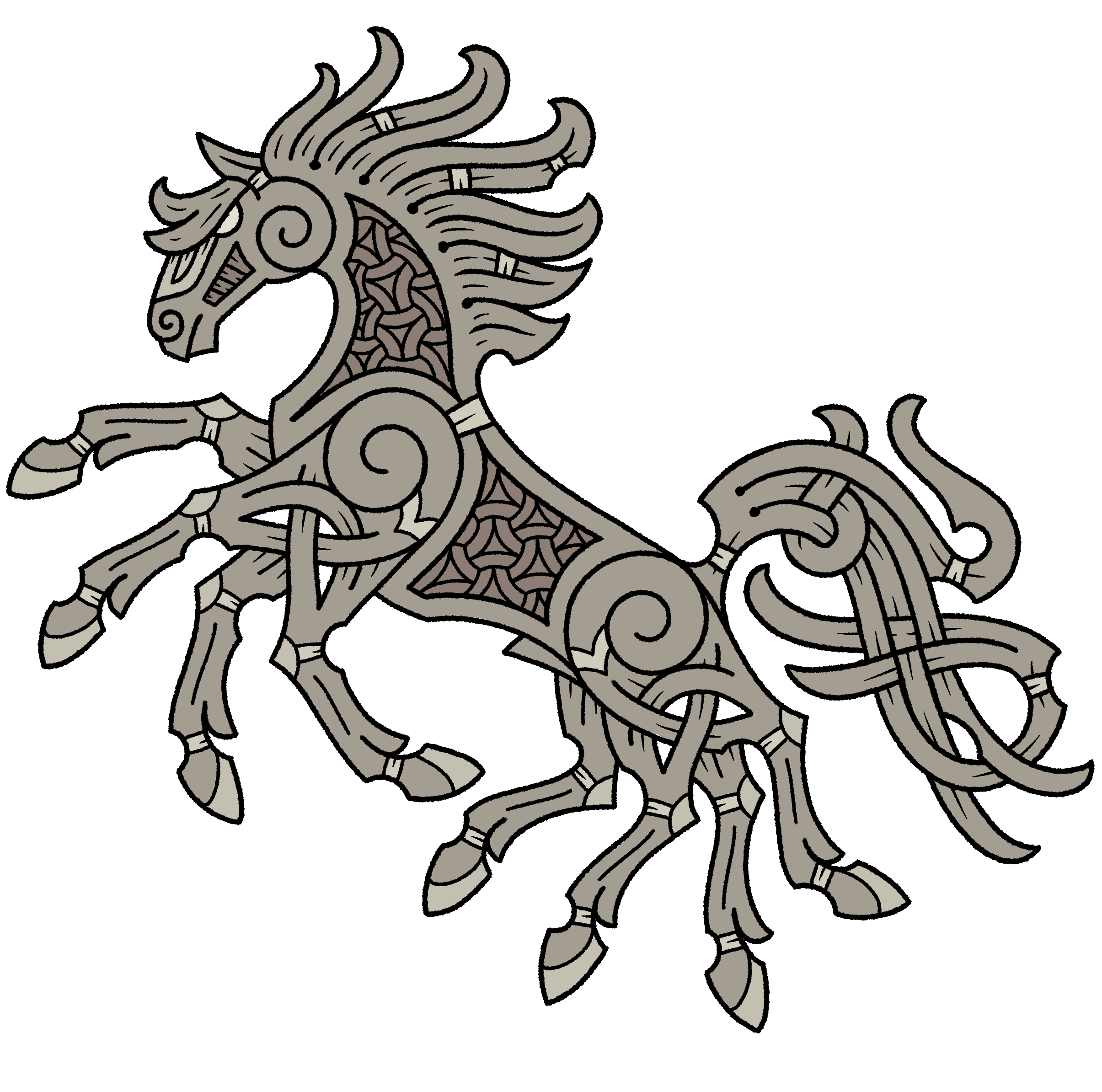
What has ten legs, three eyes and one tail?
A stranger puts this riddle to King Heiðrekr in Hervarar saga, and the king has the answer: Óðinn riding Sleipnir, eight legs and two, two eyes and one.
The stranger is the one-eyed Óðinn, in disguise, and he has just described himself riding his steed.
Óðinn’s horse, Sleipnir, is grey and eight-legged, and the old poems call him the best of horses. He was born to Loki in the shape of a mare, and he is the horse that carries riders down into Hel and brings them back out again.
Who He Is
Name
The name comes from the Old Norse adjective sleipr, “slippery.” The ending -nir makes it a name for the one who has that quality, so Sleipnir is “the slippery one”: smooth and gliding.
Physical presence
In Snorri’s Edda, Sleipnir is grey and has eight legs. That is the whole description. No source gives Sleipnir a size, a build, a mane, markings or a temperament.
Sleipnir is male. The texts call him a horse, hestr, and use masculine forms for him throughout.
A stanza in Grímnismál ranks him the best of horses, naming the best of each kind: Yggdrasill of trees, Skíðblaðnir of ships, Óðinn of the Æsir, en jóa Sleipnir, “and of steeds Sleipnir,” then Bifröst of bridges, Bragi of poets, Hábrók of hawks and Garmr of hounds.
Family
Sleipnir’s mother is Loki, in the shape of a mare. His father is Svaðilfari, a stallion belonging to a jötunn.
Svaðilfari’s name is built from svaðil-, slippery ground or a bad fall, and -fari, traveller: the one who travels toward a fall. Father and son are named from the same slipperiness. The father’s name travels toward it. The son’s name is the slipperiness itself.
Loki has three other children, all fathered by him: the wolf Fenrir, the serpent, and Hel. The gods reject all three. Fenrir is bound. The serpent is thrown into the sea, where it lies around Miðgarðr, encircling the world. Hel is sent down to rule the dead. Fenrir’s binding holds until Ragnarǫk, when he kills Óðinn and the serpent kills Þórr.
Sleipnir is the one Loki mothered, and he is the one the gods keep as Óðinn’s own horse. Where his siblings form and hold the boundaries of the cosmos, Sleipnir crosses them.
In Völsunga saga, the hero Sigurðr rides Grani, a horse descended from Sleipnir. He is grey too. His name may come from grár, “grey,” or from grǫn, the lip or moustache.

Core character
Everything the tradition keeps about Sleipnir concerns movement and passage. He is called the best of horses, which is an understatement. Other horses carry their riders across the world. Sleipnir carries his across its borders, into the realm of the dead and out again. That puts him on the same level as his siblings. The wolf, the serpent and Hel are cosmic forces, each fixed in place as part of the structure of the cosmos. Sleipnir is one too, and his role is the crossing itself. That makes him a fitting horse for Óðinn, a god who hangs nine nights on a tree between the worlds, gives an eye for a drink from Mímir’s well, and wakes dead seeresses to question them. Sleipnir is that same reach, in the shape of a horse.

What He Does
Birth and the wall
Sleipnir’s birth is told in Snorri’s Edda. Snorri builds it around an episode that Vǫluspá, the seeress’s poem, gives only in outline: a war, a broken wall and broken oaths.
The first war in the world, between the Æsir and the Vanir, leaves the wall around the gods’ stronghold broken. A builder comes and offers to raise it again, strong enough to hold against the jötnar. His price is Freyja, and the sun and the moon along with her.
On Loki’s advice, the gods agree on terms they think he can’t meet: one winter, and no man to help him. The builder asks only for the use of his stallion, Svaðilfari. The stallion does twice the work of his master, hauling stone through the night, and three days before summer only the gateway is left.
The gods threaten Loki with death unless he finds a way out. That evening a mare runs out of the woods and whinnies at Svaðilfari. The stallion breaks loose and follows her, and the work stops. The builder falls into a rage, and in his fury the gods see him for what he is, a jötunn, and Þórr kills him. Some time later, Loki bears a foal, Sleipnir.
The gods and the jötnar are bound to each other by kinship, marriage and exchange. The bargain over the wall was one of those ties, and the gods break it through trickery. From here Vǫluspá turns toward Ragnarǫk, when the jötnar come for the gods.
In the same bargain that breaks their bond with the jötnar, the gods gain the horse that will carry Óðinn across every threshold of the cosmos.
The race with Gullfaxi
The clearest measure of Sleipnir’s excellence is a wager: Óðinn bets his own head on him. The race that follows is told only in Snorri’s Edda. The duel after it is much older, told in the 9th- or 10th-century poem Haustlǫng.
Óðinn rides Sleipnir into Jötunheimr, where the jötunn Hrungnir admires the horse. Óðinn bets his head that there is no better horse in all Jötunheimr. Hrungnir claims his own horse, Gullfaxi (‘golden mane’), is far faster, and takes him up on it. Óðinn turns for home with Hrungnir on Gullfaxi close behind. Sleipnir stays ahead the whole way. Hrungnir is so caught up in his fury that he doesn’t notice where the chase has taken him until he is through the gates of Ásgarðr.
A jötunn is now standing inside the gods’ stronghold while Þórr is away, and hospitality requires them to offer a visitor drink. Hrungnir drinks until he is drunk and boasts that he will carry Valhǫll off to Jötunheimr, sink Ásgarðr, kill every god, and take Freyja and Sif home with him. The gods send for Þórr. Hrungnir tells him that Óðinn himself guaranteed his safety, and that there is little glory in killing an unarmed man. So he challenges Þórr to a duel instead.
At the duel, Þórr’s hammer shatters Hrungnir’s whetstone and strikes him down. He falls forward with his leg across Þórr’s neck, and no one can lift it until Þórr’s son Magni, three years old, throws it off. Þórr gives him Gullfaxi as a reward. Óðinn objects that the horse should have gone to him, not to the son of a jötunn woman.
Riding to Hel and back
Sleipnir’s defining threshold crossing is into the realm of the dead, and he makes it twice in the story about Baldr’s death. In the short poem Baldrs draumar, Óðinn rides him down before Baldr dies, and in Snorri’s Edda, Hermóðr rides him down to get Baldr back from the dead.
Baldr has been dreaming of his death. Óðinn saddles Sleipnir and rides down toward Hel. The road rumbles under Sleipnir as Óðinn rides on to Hel’s high hall. There he wakes a dead seeress from her grave and makes her tell him what waits for his son.
The second ride comes after Baldr is dead. Hermóðr offers to ride to Hel and ask for him back, and he takes Óðinn’s horse. He rides nine nights through valleys so dark he can see nothing, until he reaches the river Gjǫll and its gold-roofed bridge. The maiden who guards it, Móðguðr, tells him that five troops of dead men crossed the day before, and the bridge shook less under all of them than it does under him alone. At the gate of Hel, Hermóðr tightens the girth and spurs Sleipnir on, and the horse clears the gate without touching it.
Sleipnir brings both riders down to Hel and safely back, though neither can change Baldr’s fate.
The Överhogdal tapestries
The Överhogdal tapestries show eight-legged horses moving past a great tree. Sleipnir is not named, and the horses may not be him, but the pairing of eight legs and the tree is unmistakable.
The tapestries are five woven pieces found in 1909 in the church at Överhogdal, in Härjedalen, which was part of Norway until 1645 and is now in Sweden. Radiocarbon dating places all five between 1040 and 1170, in the decades of the conversion. Textiles from this period almost never survive.
Eight-legged horses on the Överhogdal tapestries


Across the pieces, riders and animals move in procession from right to left past a great tree with a bird of prey at its top. Some of the horse-like figures in the procession have eight legs. On one piece, an eight-legged horse stands at the foot of the tree.
Most readings of the tapestries agree that the tree is the world tree. Set beside it, eight legs mark the creatures that travel through the whole cosmos. The old poems know a ride like this. In Grímnismál the gods ride every day to give judgement at the tree, and when Snorri lists their horses, Sleipnir comes first.
Scholars have read the tapestries as Ragnarǫk, as the Christian apocalypse, and as a blend of the two. Whichever holds, the eight-legged horse stands at the centre of the cosmos as the creature made to move through all of it. It is the role Sleipnir fills in the old poems.
The runes on Sleipnir’s teeth
In the poem Sigrdrífumál, the valkyrie Sigrdrífa teaches Sigurðr runes, and tells him where the runes came from and how they spread through the world.
The runes, she says, were carved on the shield that stands before the sun, on the ear and the hoof of the sun’s horses, on Sleipnir’s teeth, on a bear’s paw and a wolf’s claws, on Bragi’s tongue, on the point of Gungnir, on Grani’s breast, on a Norn’s nail. Then they were all scraped off, mixed into the holy mead, and sent out far and wide: some to the Æsir, some to the elves, some to the Vanir, and some to humankind.
Many of the things the runes pass through are the powers the cosmos runs on: the sun and its horses, Óðinn’s spear, the Norns who shape fate, poetry itself. Sleipnir is inscribed among those powers, and so is his descendant Grani.
The Gotland picture stones
Two picture stones from Gotland, both carved around the 9th century, show a rider on an eight-legged horse. For a long time the rider was taken to be Óðinn on Sleipnir, riding to Valhǫll. But read as a whole, the stones tell a different story: Sigurðr on Grani, and a story of revenge and inevitable fate.
Sigurðr’s story was the most widely depicted heroic legend of the Viking world, and fate runs through all of it. It includes the dragon Fáfnir’s hoard with the cursed ring Andvaranaut, the valkyrie Sigrdrífa, the betrayal and his death. It appears on stones from Gotland and the Swedish mainland to the Isle of Man and northern England. On several Swedish runestones the same scene recurs: a man holding a ring, met by a woman holding a drinking horn.
Eight-legged horses on the Gotland picture stones


That meeting is echoed on the Tjängvide I picture stone. The rider on the eight-legged horse is met by a woman with a drinking horn, and beneath the horse’s legs are flame-like triangles. In Sigrdrífumál, Sigurðr rides through flames to wake Sigrdrífa, the valkyrie who teaches him runes. She welcomes him with a horn of mead, the drink bound up with wisdom and with the runes she is about to teach him.
The Ardre VIII picture stone gives further clues that the rider on the eight-legged horse at the top of the stone is Sigurðr. Its lower half is built around revenge: Loki bound for Baldr’s death, Vǫlundr taking vengeance on the king who held him captive, Signý avenging her father. Its upper half also shows a hall and a dead man, most likely Sigurðr’s own death at the hands of the sons of Gjúki. The whole stone, top to bottom, is about revenge, with Sigurðr on the eight-legged horse as its central motif.
The carvers gave Sigurðr’s horse the one feature that belongs to Sleipnir and trusted their audience to understand it. Centuries before Völsunga saga was written down, anyone looking at these stones knew whose kin the horse was.
How He Connects
Sleipnir had no cult of his own. He belongs to Óðinn, and no place names, offerings or seasonal customs are tied to him alone. What carries him into later tradition is stories: a mark left in the Icelandic landscape, and a rider heard passing overhead in the winter dark.
Ásbyrgi
In northeast Iceland lies Ásbyrgi, a horseshoe-shaped canyon with sheer rock walls, carved out by two catastrophic glacial floods thousands of years apart. The story told about it is that Sleipnir touched the ground here with one hoof and left his print in the land.
The earliest written trace of that story is Einar Benediktsson’s poem Sumarmorgunn í Ásbyrgi, written in 1893 and published in 1897. His family’s farm lay by the canyon. Whether Einar invented the hoofprint or put an older local story into verse is unknown, since no earlier record survives either way.
The huntsman
In Danish and Swedish folk tradition, a spectral hunter rides through the winter nights with his hounds. He goes by dialect forms of Óðinn’s name, Våjens, Goen and Oden, and in Sweden the noise of the hunt passing overhead is called Odens jakt, Oden’s hunt. Often he is chasing a supernatural woman, like the long-breasted Slättenlångpäta. In Denmark the hunter is sometimes a king instead: Valdemar Atterdag, dead since 1375, took over the role generations later.
Norway’s Oskoreia is a different ride: a host of the dead, led by other figures, with no Óðinn in it. The two traditions were merged in the 19th century, when Welhaven’s poem Aasgaardsreien and Arbo’s painting of it put Óðinn at the head of the Norwegian host.
The stories call the rider by Óðinn’s name, and Óðinn’s horse is Sleipnir.