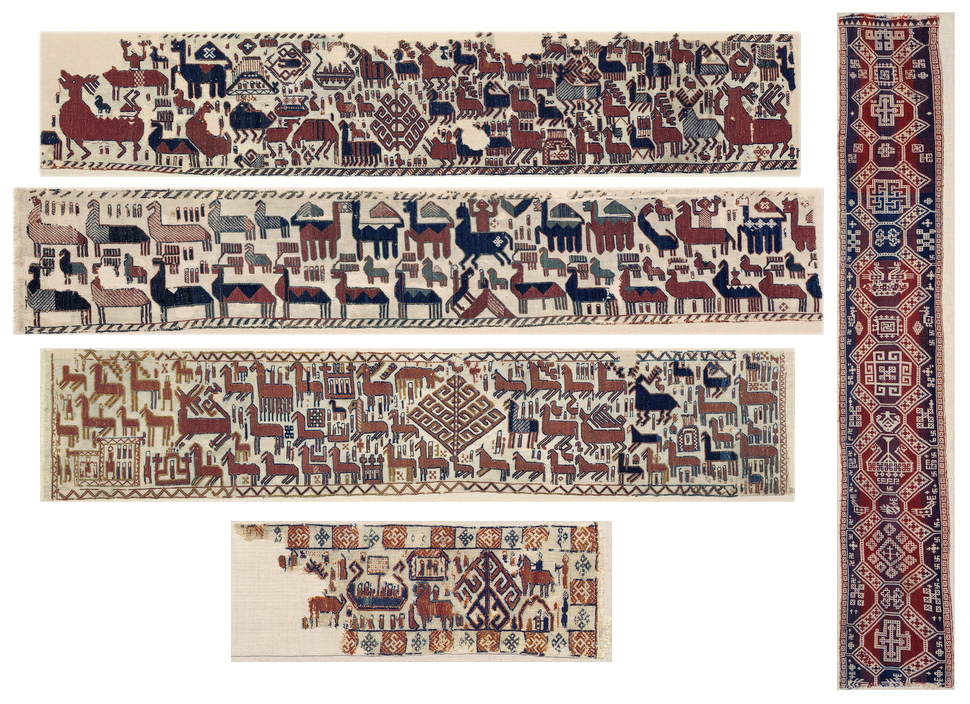
The Överhogdal tapestries are made up of five narrow lengths of woven cloth, deep red and blue on an undyed ground. Across them moves a crowd of several hundred small figures: people, horses and riders, animals real and otherwise, passing trees, buildings and ships. Nearly all of them are heading the same way, from right to left.
The tapestries come from Överhogdal church in Härjedalen. Radiocarbon dating places their making between 1040 and 1170. Today they hang at Jamtli, the county museum in Östersund, and they are among the very few figured textiles to survive from Scandinavia in this period.
For more than a century, people have tried to interpret the scenes depicted. They have been read as myth, as saga, as a missionary’s journey and as the end of the world. Very little of it can be said with any real confidence.
The find
In 1909, while Överhogdal church was being renovated, a bundle of old cloth was cleared out of the sacristy woodbox and moved to one of the storehouses beside the church. The following year an artist collecting objects for the county museum came across it there. The bundle turned out to be five pieces sewn together into a single coverlet, and the stitching thread has since been dated to the 1300s.
The missing fragments were tracked down in the village a year later. One of them had become a blanket for a five-year-old girl’s doll.
Dating
Radiocarbon dating places the tapestries between 1040 and 1170, which is the very end of the Viking Age and the beginning of the Middle Ages in Scandinavia. Strictly speaking, the method dates the growing of the flax, hemp and wool, and the weaving came some time after. Earlier tests gave a somewhat older range, which is why they are still often described as Viking textiles.
Those are the decades in which the region was becoming Christian. In neighbouring Jämtland, a runestone raised at Frösön around the middle of the 11th century records that Austmaðr, son of Guðfastr, lét kristna Jamtaland, “had Jämtland made Christian”.

Making
Four of the five pieces (IA, IB, II and III) carry the figures. The fifth, IV, is a different kind of cloth altogether: a double weave with a geometric pattern.
The figure pieces are woven on a ground of linen. In IA and IB, fibre analysis has found hemp mixed in with the flax. The figures are worked in two-ply wool spun from the fleece of native-breed sheep, and the colours come from plants: madder for the red, woad for the blue and weld for the yellow.
The technique is called soumak. As the weaving builds up, the pattern thread is carried forward over six or nine warp threads, then wrapped back around two or three of them, and so on across the figure. Once the whole width has its pattern threads in place, a plain linen weft is passed through to lock them down. At first the tapestries were taken for embroidery, until it became clear that the pattern thread never once pierces a thread of the ground. Soumak is among the oldest weaving techniques in Europe. It went out of fashion in Scandinavia during the Middle Ages, and today survives mostly in rugs from the Caucasus and Anatolia.
The technique also shapes the picture. Each wrapped pattern thread pulls on the cloth, so the figures have to be spread fairly evenly across the surface or the weave distorts. Part of the crowded, scattered look of the tapestries is simply what soumak requires.
The tapestries were most likely woven on an upright warp-weighted loom, the standard loom in Scandinavia at the time, with the warp held taut by weights of stone or clay. IA and IB came off the same warp. They share a threading error, and the same mix of hemp and flax. The patterns and techniques point to local production, and hemp grows well on the region’s soils, but where exactly they were woven is unknown.
Who wove them is not recorded either. In the Old Norse sources, weaving is consistently women’s work, and the Överhogdal tapestries were very likely made by women too.

The imagery
The figure pieces depict people on foot and on horseback, animals of many kinds, beasts with open jaws, birds, trees, buildings, ships and a sledge. Nearly all of them move in the same direction, right to left, in a long procession packed into three or more rows across the width of the cloth.
The people are small compared to the animals, but there are more of them. One careful count gives 323 human figures and 149 four-legged animals across the four figure pieces.
The procession keeps being broken. Buildings are shown in cross-section, with figures standing or lying inside. Trees run the full height of the image, from its lower edge to its upper one. Here and there an animal is turned against the current, and birds are set crosswise to everything around them.
The figures carry only a few objects: spears, a handful of axes and swords, a block chair. Some of the absences stand out as much. There are no battle scenes, and none of the drinking horns so common on the Gotland picture stones.
None of the figures shows anything of the body that would mark them as male or female. What varies is dress, hair and posture. By the same count, 193 figures wear ankle-length dresses and are usually read as women, 97 wear knee-length tunics and are usually read as men, and 33 carry no marking either way. Within the ankle-length group, 19 figures stand apart from the rest: taller, in long trailing dresses, and most often shown inside the buildings. Two of them hold spears.
Wherever the procession is going, it lies beyond the edge of the cloth.
The individual tapestries


IA and IB
IA measures 184 × 35 cm, and IB 195 × 35 cm, the longest of the five. Between them they hold 162 human figures and some ninety four-legged animals.
At the centre of IA stands a large tree, running more than half of the height of the cloth. To the left of it is a horse with eight legs.
IB includes a rider with both arms raised. Of the 110 figures on the two pieces read as women, only four wear the long trailing dress.

II
II, at 184 × 37 cm, is the only piece that survived in its full length. It carries 129 human figures and 55 four-legged animals, among them a group of horned animals. Buildings stand along the procession, and a handful figures ride on horseback. None of the trailing-dress figures appear on this piece.

III
III is the smallest piece at 67 × 24 cm, and the most damaged, with part of its left side missing. It holds 32 human figures and only three four-legged animals, but the highest share of trailing dresses: 12 of the 21 figures read as women wear them.
A sailing ship with its crew sits beside an upside-down tree. There is a house with three figures inside, a smaller procession with a rider, and figures carrying axes. A border runs along three sides, made up of squares filled with crosses and swastikas, both common geometric signs in medieval ornament centuries before the swastika took on its modern associations.

IV
IV, at 176 × 30 cm, is the double weave. Its pattern is built from repeated geometric fields, and set in between them are smaller figures: birds, animals, and what looks like a ship.
A century of readings
The scenes are too stylised to settle on any one story, and over the past century they have been made to fit several: the Christianisation of the region by a missionary, the legend of the Vǫlsungs, the Book of Revelation, Ragnarök, and episodes from the sagas of the Norwegian kings. What story the tapestries tell, if they tell one at all, remains open.
Context and relatives
Figured hangings like these were valued things. Medieval church inventories, most of them Icelandic, show textiles making up a large share of a church’s property, with hangings brought out and put up for special occasions. Old Norse literature describes the same kind of cloth running along the walls of a hall at a feast. Where the Överhogdal tapestries first hung is not known. Their long, narrow format suits a band at around head height, running the length of a wall or around a whole room, so that the people inside are surrounded by the procession.
They have relatives. The oldest are the tapestry fragments from the 9th-century Oseberg ship burial in Norway, with processions of their own: people, horses and wagons. The Skog tapestry from Hälsingland is later, and close in its figures. A woven band from Rennebu in Trøndelag shows a house with three figures inside, much like the house scene on III, and a double-woven coverlet from Kyrkås in Jämtland is close to IV.
Sources
Inscriptions
J RS1928;66. Frösöstenen (the Frösö runestone). Mid-11th century. Frösön, Jämtland.
Literature
Franzén, Anne Marie & Nockert, Margareta. 1992. Bonaderna från Skog och Överhogdal och andra medeltida väggbeklädnader. Kungl. Vitterhets Historie och Antikvitets Akademien.
Göransson, Eva-Marie. 1995. Människor i rum av tid: bilder av kvinnor och män på Överhogdalsbonaderna. Fornvännen90(3). Kungl. Vitterhets Historie och Antikvitets Akademien.
Horneij, Ruth. 1991. Bonaderna från Överhogdal. Jämtlands läns museum.
Mjönes, Staffan. 2010. Det uppochnedvända trädet: vikingar och samer i Överhogdalsbonad III. Arkeologi i norr 12. Umeå universitet.
Oscarsson, Ulla. 2012. De gåtfulla Överhogdalsbonaderna. In Människor i vikingatidens Mittnorden: föredrag vid de Mittnordiska arkeologidagarna i Östersund 2010. Fornvårdaren 32. Jamtli förlag.
Skoglund, Git; Nockert, Margareta & Holst, Bodil. 2013. Viking and Early Middle Ages Northern Scandinavian Textiles Proven to be made with Hemp. Scientific Reports 3: 2686. Nature Publishing Group.
Web
Jamtli. 2024. Överhogdalsbonaderna – en av världens märkligaste textilskatter.