
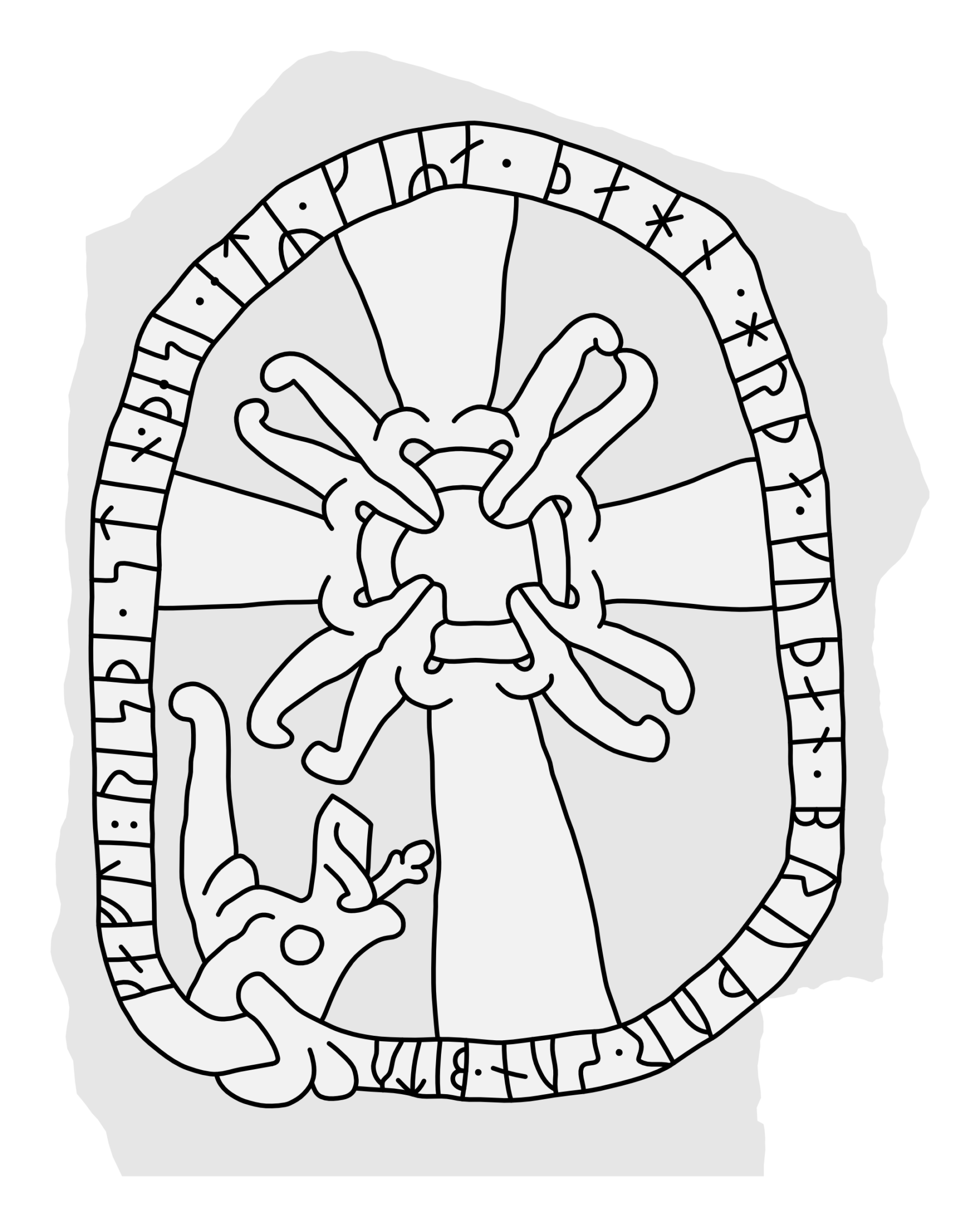
c. 1010 – 1040
Characterisation of the style
As defined by Anne-Sofie Gräslund
Overall impression
Compact, close and blunted. The curves of the animals are often a little angular and the bow line pressed together.
Head
Normally with a very snub nose with a thick upper lip and a strong, steeply cut-off lip lappet.
Eye
Round.
Ear
High set, rounded and erect. The ears and one or more scrolls often form a “crown”.
Mouth
Normally open, with a rather short lower lip.
Feet
Do not occur.
Tail
Rolled up, sometimes with a thumb-like protuberance downwards, or consisting of several scrolls of similar length.
Additional snakes
Do not occur.
Layout
One rune animal along the edge of the carved area is the most common, but two rune animals occur. Normally there is no over-crossing (i.e. the head cutting over the tail or vice versa).
Union Knot
Occur generally.
Cross
Very frequent.
Examples


Sources
Danske Runeindskrifter, http://runer.ku.dk
Gräslund, Anne-Sofie, 2006. ‘Dating the Swedish Viking-Age rune stones on stylistic grounds’. Runes and their Secrets – Studies in runology.
The Scandinavian Runic-text Data Base.
Sveriges runinskrifter.