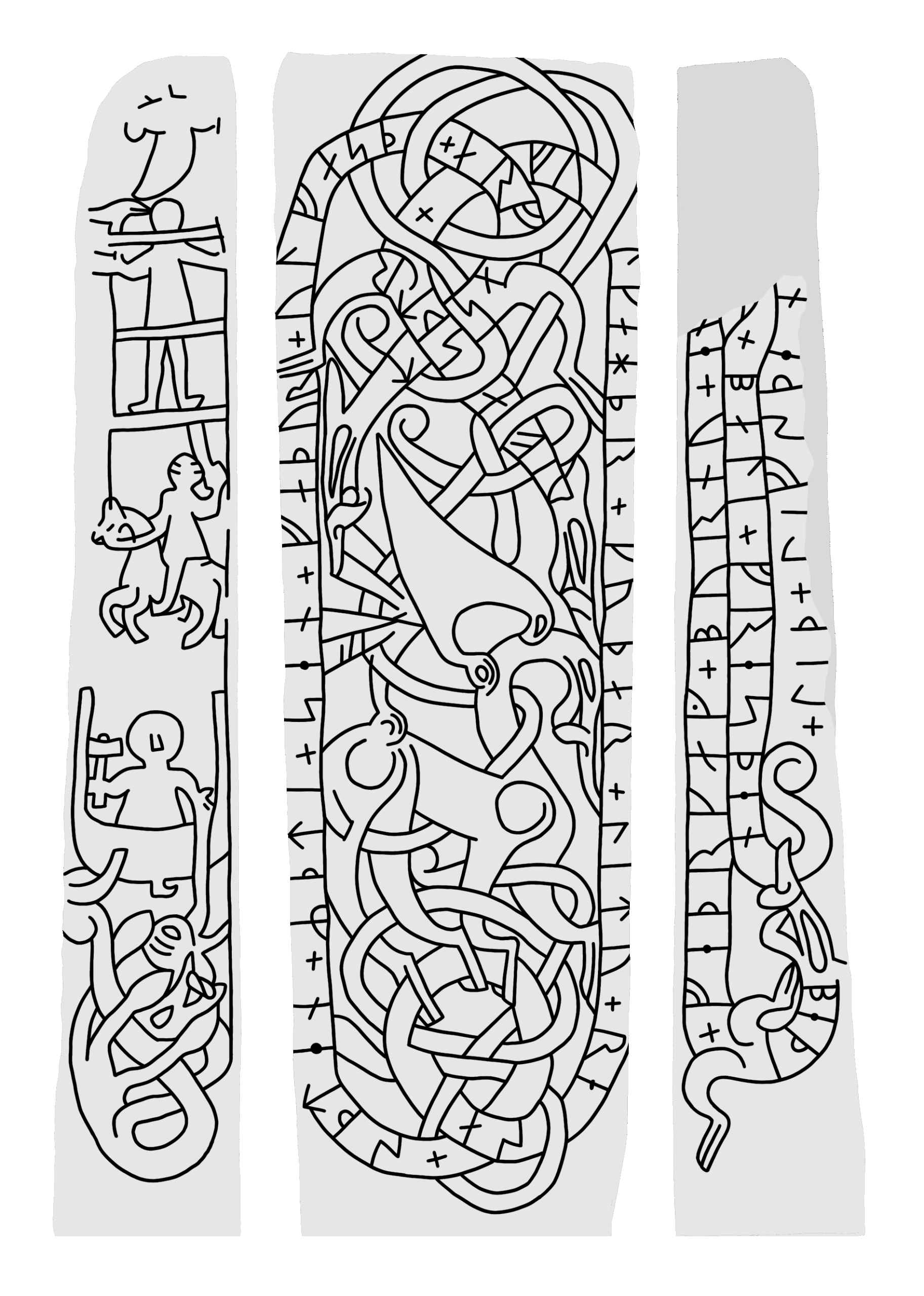
The inscription is paired with a scene showing Thor’s fishing trip, one of the most famous episodes from Nordic mythology. Thor stands in a boat, hauling up the Miðgarð serpent on his line while striking at it with his hammer, Mjölnir. The serpent coils beneath the boat, and the imagery captures the moment of struggle described in later mythic sources.
Runic Inscription
Transliteration
§A uifasþtr + fulkahþr + kuþar + litu + resa + sþten + ʀþti + sen + faþur + ulfasþ + arfast
§BP beþi + feþrkag + burnu + e(n) …(ʀ) + bali + fresþen + liþ + lifsþen… …
§BQ beþi + feþrkag + burnu + e(n) … + bali + fresþen + liþ + lifsþen
Transcription
§A Vifastr, Folkaðr, Guðvarr(?) letu ræisa stæin æftiʀ sinn faður Holmfast, Arnfast.
§BP Baðiʀ fæðrgaʀ brunnu, en [þæi]ʀ Balli, Frøystæinn, lið Lifstæin[s ristu].
§BQ Baðiʀ fæðrgaʀ brunnu, en [þæiʀ] Balli, Frøystæinn, lið Lifstæinn.
Translation
§A Véfastr, Folkaðr, Guðvarr(?) had the stone raised in memory of their father Holmfastr, (and in memory of) Arnfastr.
§BP Both father and son were burned, and Balli (and) Freysteinn, of Lífsteinn’s retinue, carved.
§BQ Both father and son were burned, and Balli (and) Freysteinn (and) Lífsteinn (carved?).