
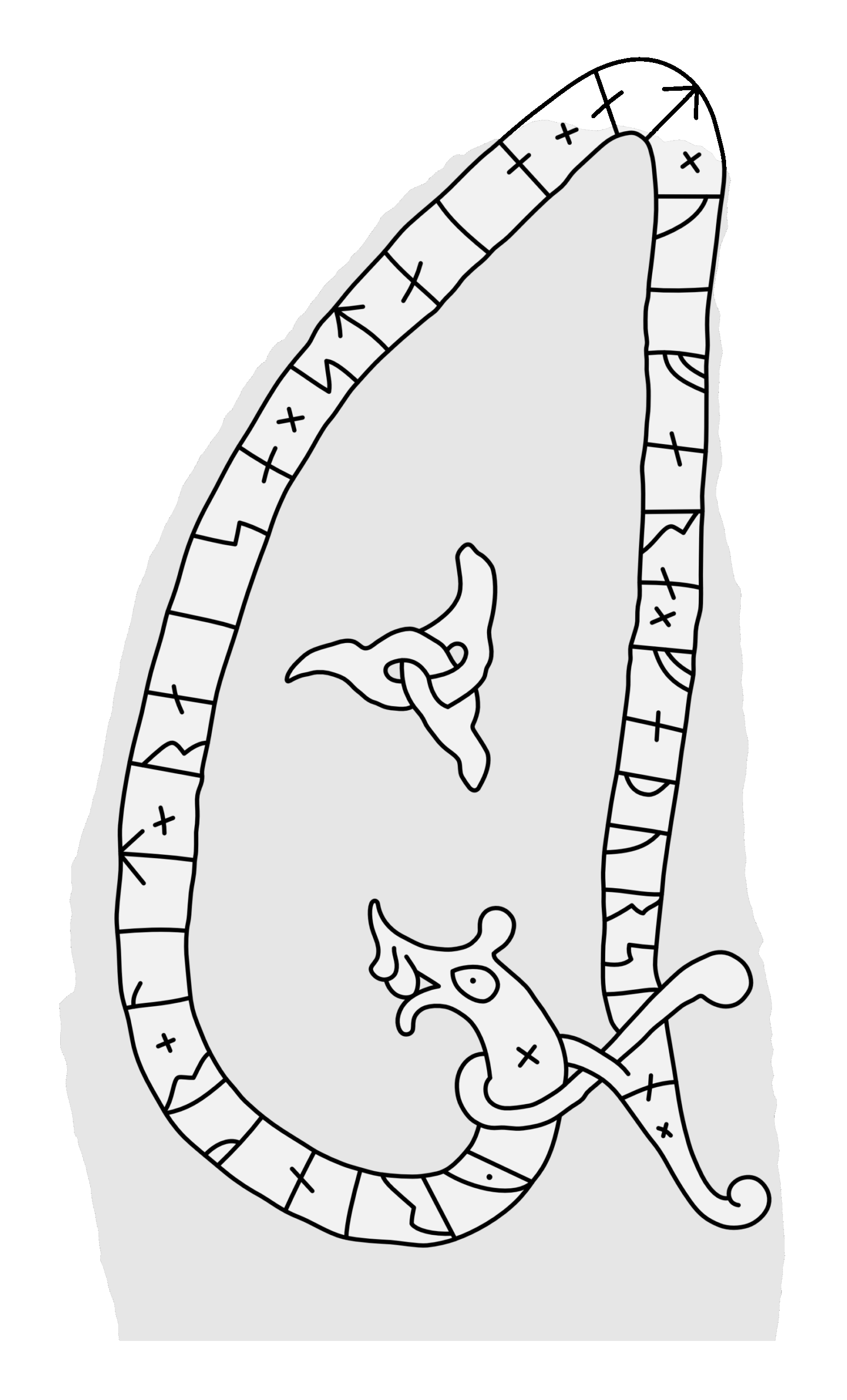
c. 1020 – 1050
Characterisation of the style
As defined by Anne-Sofie Gräslund
Overall impression
Most often unresilliant and angular, although less so than in Pr 1. The rune animals are rather substantial, but there are also some thinner examples.
Head
Characterised by a concave line from ear to nose tip.
Eye
Round or drop formed, sometimes with a point in it.
Ear
High set, erect or slightly bent forward.
Mouth
Normally open, sometimes with a tongue, the upper lip and the nose tip strongly bent upwards. There is often a balance between the upward line of the ear and that of the nose. Distinct, round lip lappet. Marked lower lip in a semicircular bow.
Feet
Occur only seldom, slightly rounded on short legs.
Tail
Rolled up, often with a thickened end and a thumb-like protuberance downwards. The rolled tail and the protuberance generally correspond to the shape of the head.
Additional snakes
Occur seldom, a neck crest or a union knot is sometimes transformed into long tendrils, giving the same decorative impression as a snake.
Layout
One (sometimes two) rune animal(s) along the edge is the most typical layout.
Union Knot
Occur generally.
Cross
Very frequent.
Examples


Sources
Danske Runeindskrifter, http://runer.ku.dk
Gräslund, Anne-Sofie, 2006. ‘Dating the Swedish Viking-Age rune stones on stylistic grounds’. Runes and their Secrets – Studies in runology.
The Scandinavian Runic-text Data Base.
Sveriges runinskrifter.