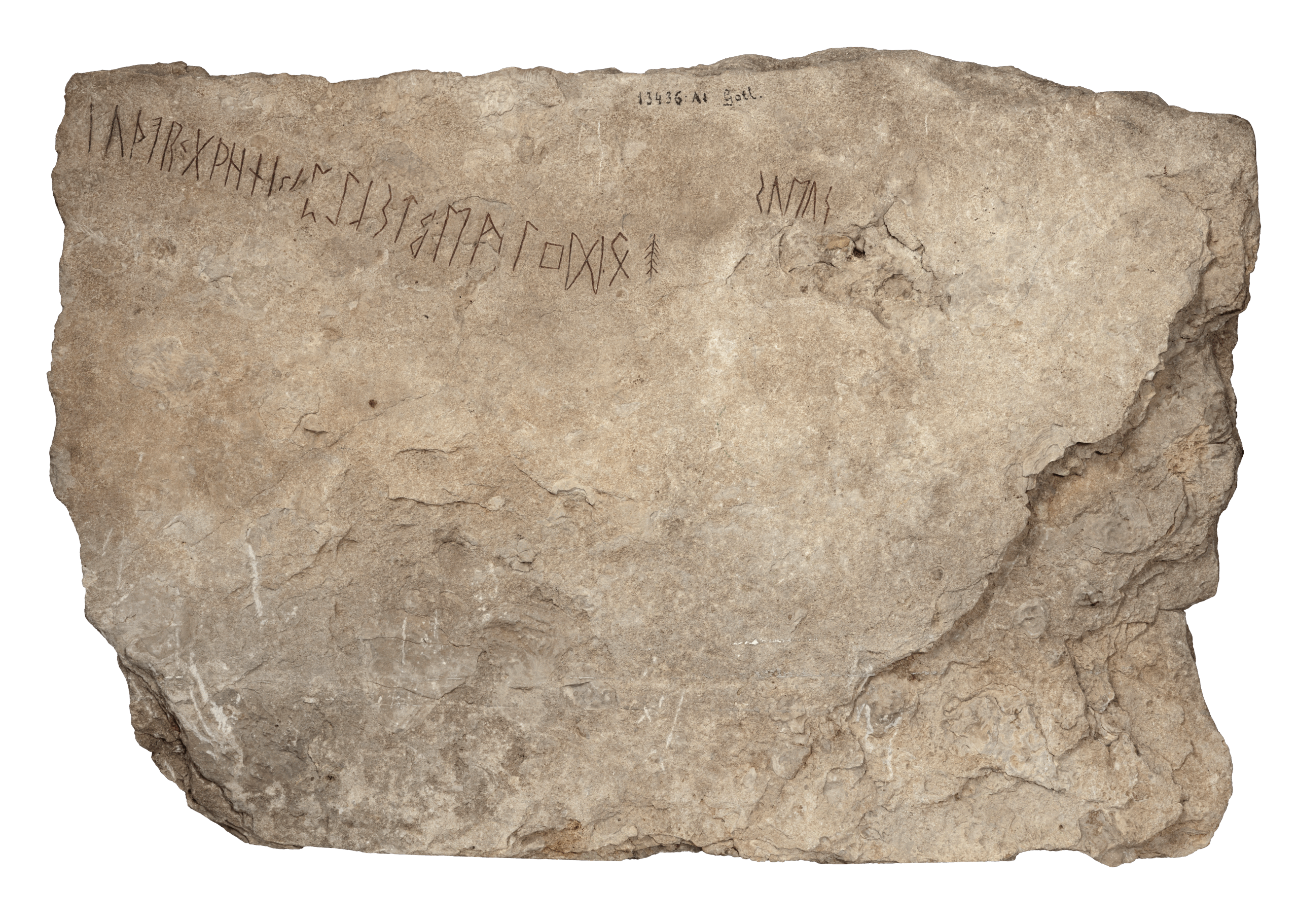
The slab was found in 1903 as the cover of a stone cist grave at Kylver, Stånga parish, Gotland. Most Elder Futhark inscriptions appear on portable objects: weapons, combs, bracteates. The inscription was carved on the inner face and was not visible from outside the grave.
Three elements are carved on that face: the complete 24-rune Elder Futhark sequence, ᚠᚢᚦᚨᚱᚲᚷᚹᚺᚾᛁᛃᛈᛇᛉᛊᛏᛒᛖᛗᛚᛜᛞᛟ; a second line reading ᛋᚢᛖᚢᛋ sueus, a word that reads identically in both directions and whose meaning remains unresolved; and a tree-shaped symbol, read by some scholars as a stacked Tiwaz rune, by others as a yew motif (G 88).
The Kylver stone carries the oldest known complete Elder Futhark sequence. The purpose of the inscription has not been settled. Proposed readings include protective function, a binding of the dead, and a practice carving, and the burial context, unusual for runic inscriptions of this period, remains part of the interpretive problem.