
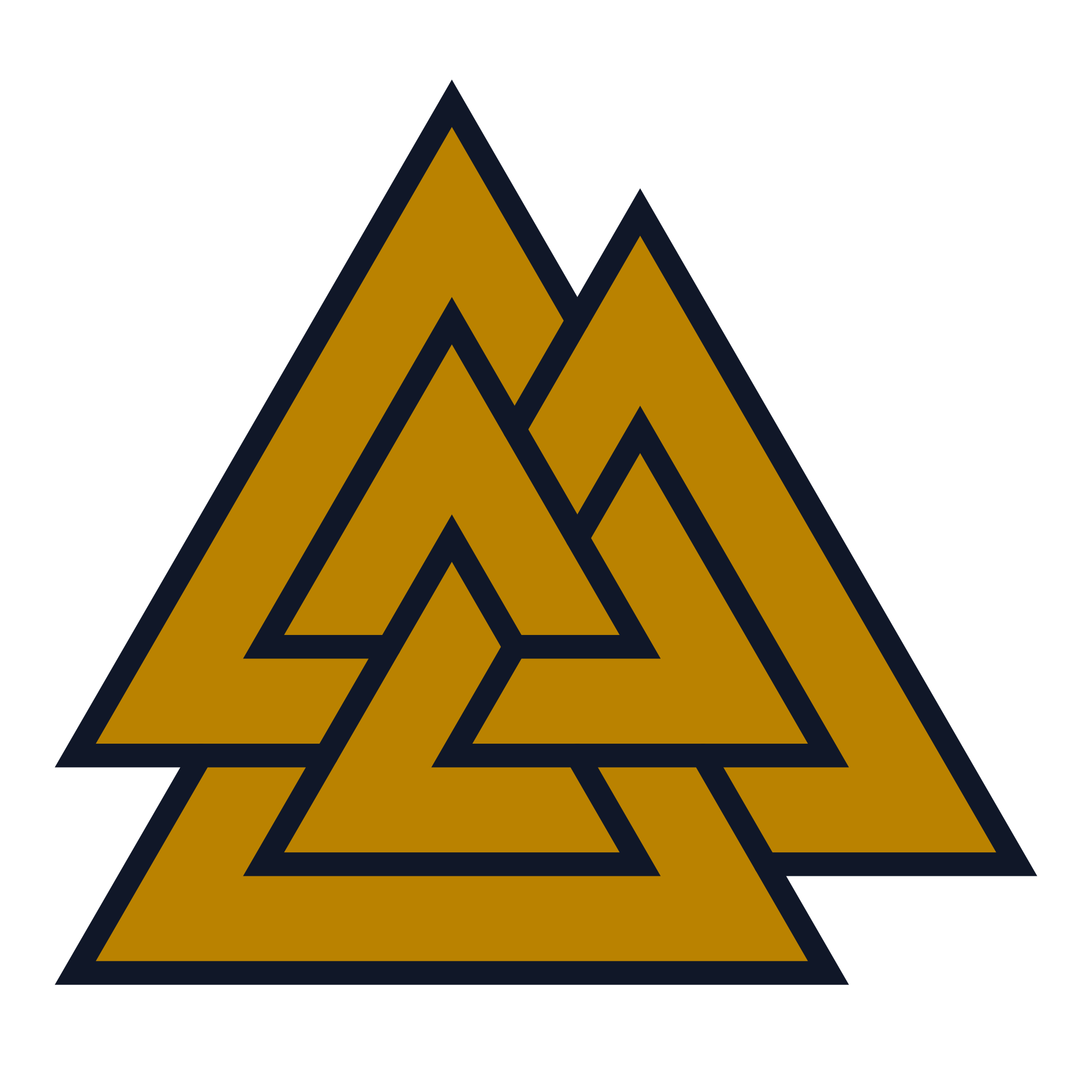
Hrungnir’s Heart, or the Valknut, is one of the most iconic and enigmatic symbols of the Viking Age. Composed of three interlocking triangles, it appears on grave goods, picture stones, and carved objects across the Scandinavian world. Though the modern name ‘valknut’ is a recent invention, the symbol itself, and its older plausible association as ‘Hrungnir’s heart’, has deep roots in Nordic mythology and heroic literature. While the exact meaning and significance of the symbol remain uncertain, one compelling interpretation is that it represents the brave and steady heart of a warrior.
The Symbol
Hrungnir’s Heart appears in two main variations in the archaeological record:
- Unicursal: A single, continuous line weaving through itself to form three interlocked triangles.
- Tricursal: Three distinct, interlocked triangles forming a tighter, more dense pattern.

Names, Meaning, and Interpretation
Valknut
The term valknut is not attested in medieval sources. Its earliest known use appears in 18th- and 19th-century Scandinavian folk art, where it referred to four-fold woven knot patterns (looped squares, sometimes called “Saint John’s arms”). These older designs bear little resemblance to the three-triangle knot under consideration here.

Etymologically, valknut is Modern Norwegian: valr (“the slain”) + knute (“knot”). If taken at face value, “knot of the slain” fits well with its funerary contexts, but this is a retrospective name, probably not one used by the Vikings themselves.
Hrungnir’s Heart
In Snorri Sturluson’s Edda, the jǫtunn Hrungnir is said to have a heart of stone, spiked and triangular in shape. After a fateful duel with Þórr, Hrungnir is killed and his heart, described as Hrungnis hjarta, is memorialised in a curious phrase: “like the carved figure which is called Hrungnir’s heart.” Scholars have long suspected that this is a reference to the symbol explored in this article.
Þórr’s victory over Hrungnir is significant not only because Hrungnir is said to be the strongest of all giants, but also because the duel stands out in Nordic myth as an exemplary instance of formal combat: a challenge with witnesses, weapons, and honour at stake. The shape of Hrungnir’s heart, a three-pointed stone, seems to mark it as the emblem of a worthy foe, possibly even a mythic archetype of the valiant dead.
The tale also features Þjálfi’s battle with Mǫkkurkáli, a man-shaped figure made of clay and animated with the heart of a mare. Terrified when he sees Þórr, Mǫkkurkáli wets himself and collapses, a comically unworthy contrast to Hrungnir. Here, bravery and cowardice are expressed through the heart.
This same contrast appears in the Vǫlsunga saga, where the heroic Hǫgni’s heart remains still and composed even when cut from his chest, while the cowardly Hjalli’s heart trembles in fear. In both stories, steadiness of heart becomes a marker of valour.
Snorri’s account of Hrungnir provides the most suggestive historical name for the symbol: Hrungnis hjarta. Unlike Valknut, this term appears in a textual source associated with myth. The description of a spiked, three-cornered stone heart, carved into a figure that becomes known and recognised, lines up convincingly with the symbol we know today.
If the valknut is Hrungnir’s heart, it may serve multiple functions:
- A symbol of heroic steadiness
- A mark of the slain warrior or slain foe
- A sign of valour and worthiness for the afterlife
- A possible initiation mark, passed from the defeated to the victor
In this view, the symbol becomes the heart of the slain, not only a memorial to the dead, but an emblem of the cultural ideal of unwavering bravery in the face of death that runs through the myths and heroic literature of the Viking Age.
Hrungnir’s Heart in the Archaeological Record
The symbol appears throughout the archaeological record, most often in funerary contexts and ritual scenes. While no accompanying text names it, the symbol’s recurrence alongside warriors, horses, weapons, and rites of passage suggests its significance in death, bravery, and the transition to the afterlife.


Personal Objects
- Nene River Finger Ring (England): An 8th-century ring bearing the symbol, likely Early English. Possibly worn to invoke courage or mark elite identity.
- Oseberg Lid (Norway): Wooden lid with a carved Hrungnir’s Heart in the centre.
- Oseberg Bed Post (Norway): One of four carved wooden posts from a high-status Viking burial (c. 834 CE), bearing the valknut. May mark ritual or cultic importance.
- Knife Handle from Hedeby: A personal object with the symbol, perhaps meant to inspire fearlessness in battle.
- Bracteate from Nygårds, Gotland: A 10th-century pendant scratched with a valknut on the back. Possibly worn for protection, remembrance, or ritual power.


Picture Stones (Gotland, Sweden)
- Stora Hammars I
One of the most dramatic depictions. On panel four (counting from the bottom), a scene often read as a human sacrifice shows a hanged man, a spear, and birds (ravens or eagles). The valknut appears prominently. Some scholars connect this to the Vǫlsunga saga, interpreting the valknut as Hǫgni’s extracted heart, tying it to Hrungnir’s stone heart as a symbol of steadiness and valour. - Tängelgårda I
Beneath a mounted warrior (possibly Sigurðr on Grani) are two valknuts and an oddly shaped triangle. They may be interpreted as the hearts of Sigurðr’s defeated foes—King Lyngvi, Fáfnir, and Reginn—further justified by Sigurðr’s eating of Fáfnir’s heart. - Buttle Änge V
Depicts a warrior with a sword confronting a monster-like foe. A valknut appears above the monster, and possibly another above the warrior. The scene recalls Hrungnir’s duel with Þórr. The valknuts may signify the valiant hearts of both combatants, marking them as worthy. - Lillbjärs I
Shows a mounted warrior with sword and shield. A single valknut appears beneath the horse. It could represent the rider’s own heart or that of a vanquished opponent, either way marking him as valiant. - Lillbjärs III
Features a horse and rider with both a valknut and the “three interlocked drinking horns” above, alongside a woman offering a drink. The valknut likely marks the rider’s warrior-heart, while the horns may signify the skald’s heart, connecting him to both battle and poetic inspiration under Óðinn’s domains. - Smiss I
Depicts a ship with warriors beneath a valknut. The symbol may indicate the steady hearts of the men as they sail.
Modern Use
Today, Hrungnir’s Heart is widely used in heathen, pagan, and Viking-inspired contexts. It appears in:
- Corporate and brand logos
- Tattoos and jewellery
- Heathen and neopagan religious groups
However, it has also been adopted by white supremacist groups, particularly those attempting to appropriate Nordic symbols for racist ideologies. Importantly, anti-racist and inclusive heathens also use Hrungnir’s Heart often as a symbol of ancestral remembrance, personal strength, or dedication to Óðinn. Its meaning today depends heavily on context.
Sources
Westcoat, Eirik, 2015. The Valknut: Heart of the Slain?. Óðrœrir: The Heathen Journal, November 2015, Volume III.