Nordic Mythology in an English Churchyard
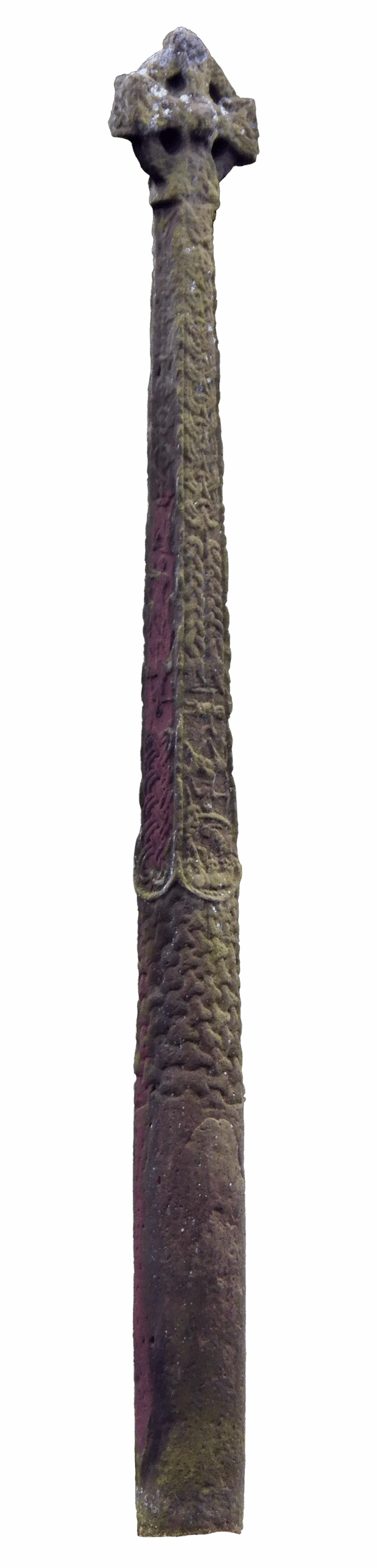
The Gosforth Cross in Cumbria is a tall stone monument carved by Scandinavian settlers in northern England in the early 900s. Its Christian cross-form is paired with a dense programme of Nordic mythological scenes, creating one of the most important visual blends of Viking and Christian tradition in Britain.
The carvings are widely understood to depict moments from the Ragnarök cycle. These include Loki bound with Sigyn catching the dripping venom, the monstrous wolf Fenrir, and a figure believed to be Víðarr, forcing open the wolf’s jaws. A mounted figure confronting a beast is often read as Odin riding to his death at Ragnarök.
The Gosforth site also preserves a second, closely related stone, known as the Gosforth Fishing Stone, carved by the same workshop. This companion piece shows Thor on his fishing trip, hauling up the Miðgarð serpent beside the giant Hymir. Because both stones share style, location, and narrative themes, the fishing scene is treated as part of the same mythic programme.
Together, the cross and its companion stone show how Scandinavian settlers used familiar myth to express identity and cosmology within a Christian setting, producing one of the richest examples of Viking art outside Scandinavia.