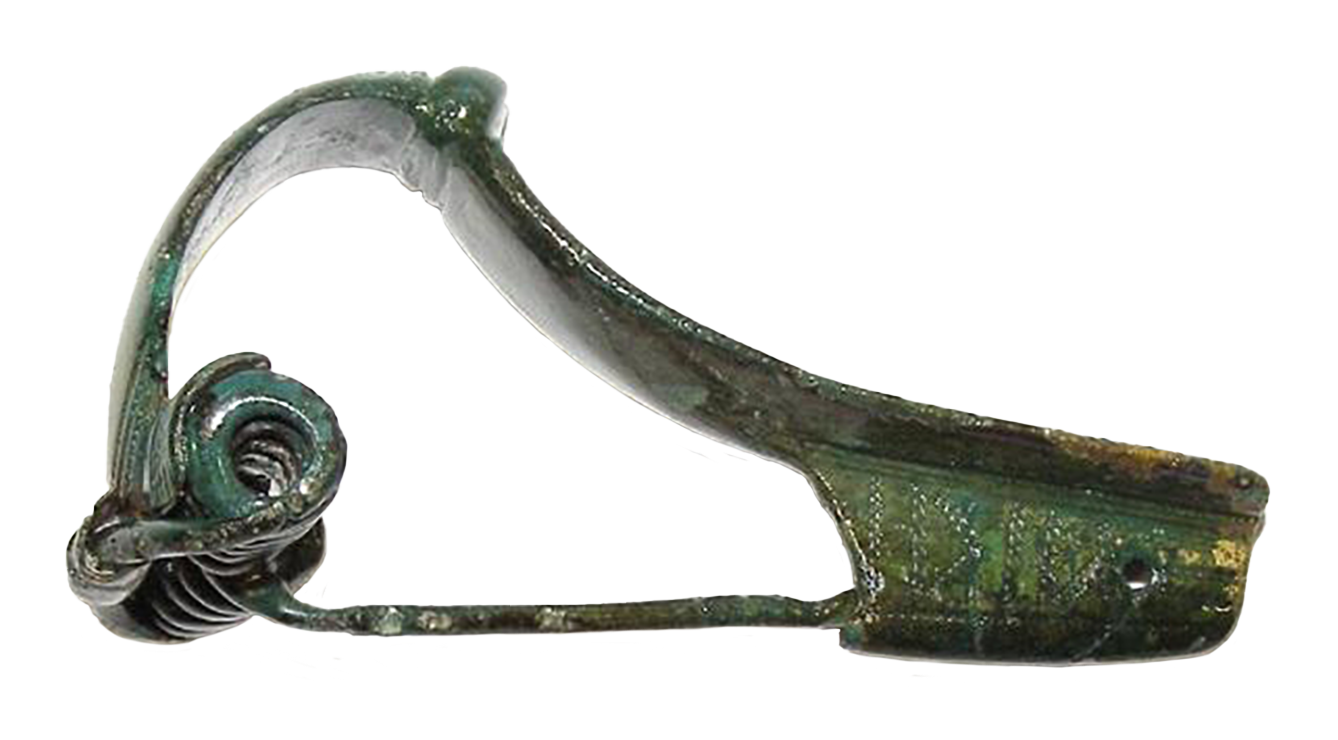
The brooch was rediscovered in 1979 in a storage cabinet at Schloss Gottorf in Schleswig-Holstein, bearing a label indicating it had been found in the town of Meldorf. The exact circumstances of its recovery are unknown; it is thought to have come from a cremation grave, likely that of a woman. Its spring-case construction dates it typologically to the first half of the 1st century CE.
Four marks are incised on the foot of the brooch. Whether they are runic, proto-runic, or Latin remains disputed. Düwel and Gebühr (1981) read them as runic hiwi, meaning roughly “for the spouse.” Odenstedt (1989) and Seebold (1994) read the same marks as Latin IDIN, a personal name. Mees (1997) also read them as runic but arrived at iṛiḷi, “to the rune-master.” No reading has achieved consensus.
If the inscription is runic, it would predate the Vimose finds by over a century and represent the oldest known runic inscription.